

Everything you need to know before you start — and why starting is the hardest part.
You've been meaning to address your brand for a while now. Maybe your logo looks like it was designed in the MySpace era (kids ask your parents). Perhaps your messaging changes depending on the latest social media trend. Maybe your organization has grown significantly, launched new products and services, or shifted markets, and your brand never kept pace.
Or maybe everything looks fine on the surface, but something just feels… off. Your team can't quite articulate what you do in a sentence. Your sales and marketing materials don't “visually” match your website. You win business despite your brand, not because of it.
Whatever brought you here, you're in the right place. This guide will walk you through everything you need to know before starting a brand strategy project. We cover what it actually involves, how long it takes, what it costs, and how to choose the right partner to do it with you, so you do not have to guess.
Why Brand Strategy Projects Fail
Before we talk about how to do this right, let's talk about how it goes wrong. Because brand projects fail all the time. And not because the creative work was bad, but because the foundation was missing.
Marketers Skip The Strategy And Jump Straight To The Logo
A new logo is not a brand. It's the output of a brand. Organizations that start by redesigning their visual identity without doing the strategic work first end up with a beautiful mark that doesn't mean anything — and a team that can't explain why it looks the way it does.
Marketers Don't Get Internal Alignment Before They Start
Brand work surfaces disagreements that organizations didn't know they had. At a minimum you should align around:
- What do we actually stand for? And for whom?
- What makes us different? Are you sure?
If leadership hasn't aligned on the answers before the project starts, the project becomes the place where those debates happen. That's slow, expensive, and demoralizing.
Marketers Don't Involve The Right People
Brand strategy requires input from people who know the organization deeply. That means senior leadership, frontline staff, long-tenured clients. Projects that are handed entirely to marketing without broader input produce brands that feel like marketing inventions rather than organizational truths.
Marketers Treat Brand Strategy As A One-time Project Instead Of A Strategic Foundation
A brand strategy isn't a deliverable you file away. It's a decision-making tool. It’s a filter. Organizations that don't plan to actually use what they build — in hiring, in marketing, in sales, new product development, in how they introduce themselves at a conference — get a beautiful document that nobody opens.
Marketing Teams Run Out Of Steam At Implementation
The creative work gets approved, the brand guide gets delivered, and then... nothing changes. The old logo is still on the email signatures. The website still communicates dated messages and features ancient images. Nobody trained the team. The project ends and the brand doesn't actually change. Often, your team does not have the bandwidth to execute all of the brand work they thought could.
Knowing these failure modes in advance is how you avoid them.
Do You Need a Rebrand, a Refresh, or a Brand Strategy?
These terms get used interchangeably, but they describe very different scopes of work. Here's how to tell them apart.
What Is Brand Strategy?
A Brand Strategy is the foundational work. It defines who you are, what you stand for, who you serve, and how you're differentiated from alternatives. It includes your positioning, your messaging framework, and your brand story. Everything visual flows from this. Do this work first to ensure success, especially if your organization has changed significantly since you last did it.
What Is A Brand Refresh?
A Brand Refresh updates the visual expression of an existing brand: think modernizing the logo, refining the color palette, updating typography, while preserving the underlying brand equity you've built. A refresh is the right call when your brand is strategically sound, well-known, but visually dated. Think of it as renovating a house that has great bones.
What Is A Full Rebrand?
A Full Rebrand changes the strategic foundation, the visual identity, and often the name. It's the right move when the current brand no longer reflects who the organization is or where it's going. Think of the bones of the house as all wrong, not just the paint color. Rebrands are bigger, more expensive, more complex, and more rewarding when done well.
Not sure which you need? Ask yourself this: Is the problem that we “look” outdated, or that we are unclear about who we are? If it's the former, a refresh may be enough. If it's the latter, start with strategy.
What Does Brand Strategy Actually Involve?
A well-run brand strategy engagement moves through four phases (which happen to be similar for a refresh and full rebrand, too). Here's what each one does and why it matters.
Phase 1: Discovery & Research
Before anyone writes a word or sketches a mark, you need to understand the organization from the inside and the outside. This means stakeholder interviews with leadership and key staff. These are not checkbox conversations, but deep ones designed to surface where the organization has been, where it's going, what's frustrating people about the current brand, and what success looks like.
It also means looking outward: understanding your competitive landscape, how comparable organizations position themselves, and where the open space is. What naming and messaging conventions dominate your category? What's already been claimed? Where is the credible differentiation available to you? What position can you own in the marketplace?
This phase builds the factual foundation that every downstream decision rests on. Skipping it is how you end up defending creative decisions with opinions instead of evidence.
What do you get?
You get a stakeholder interview summary, competitive landscape analysis, key strategic insights that drive everything that follows.
Phase 2: Brand Positioning & Story Development
This is where the strategic foundation gets built. Who are you, really? Who do you serve, specifically? What do you do that your competitors or alternative solutions don't? And can you prove it? What's the one thing you most need your audience to believe about you?
The outputs of this phase become your decision-making filter. Every subsequent creative decision — naming, visual identity, messaging — gets measured against the positioning platform. Does this logo feel like who we said we are? Does this headline say the thing we decided matters most? Good positioning makes those questions answerable.
This phase also produces your brand story: a narrative that captures your purpose, your differentiation, and your value in a way that resonates emotionally, not just rationally. Not a tagline. Not a mission statement. A story.
What do you get?
You get a positioning platform, brand story, audience profiles, messaging framework.
Phase 3: Visual Identity Development
Now, and only now, do we design the logo. Visual identity work translates the brand strategy into a visual system, including visual identity, color palette, typography, graphic elements, and photography direction. Done well, every element of the visual system is a design decision that can be explained in terms of the strategy. The colors mean something. The typeface says something. The mark does something.
The deliverable isn't just a logo file. It's a brand identity system designed to work consistently across every application: digital, print, signage, social, presentations, and anything else your brand shows up in.
What do you get?
You get a logo in all formats and variations, color system, typography system, brand style guide, application examples.
Phase 4: Brand Guidelines & Rollout Toolkit
A brand without guidelines is a brand that will be executed inconsistently. The brand guide documents everything your team, and your extended team (e.g., vendor partners) need to apply the brand correctly: logo usage rules, color values, typography hierarchy, photography standards, and messaging guidance.
The rollout toolkit makes implementation practical, and includes email signature templates, letterhead and business cards, presentation masters, and signage specs. These are the tools that make the new brand real in everyday work.
What do you get?
You get a brand guide (print or digital), rollout toolkit, and templates for common applications.
How Long Does This Take?
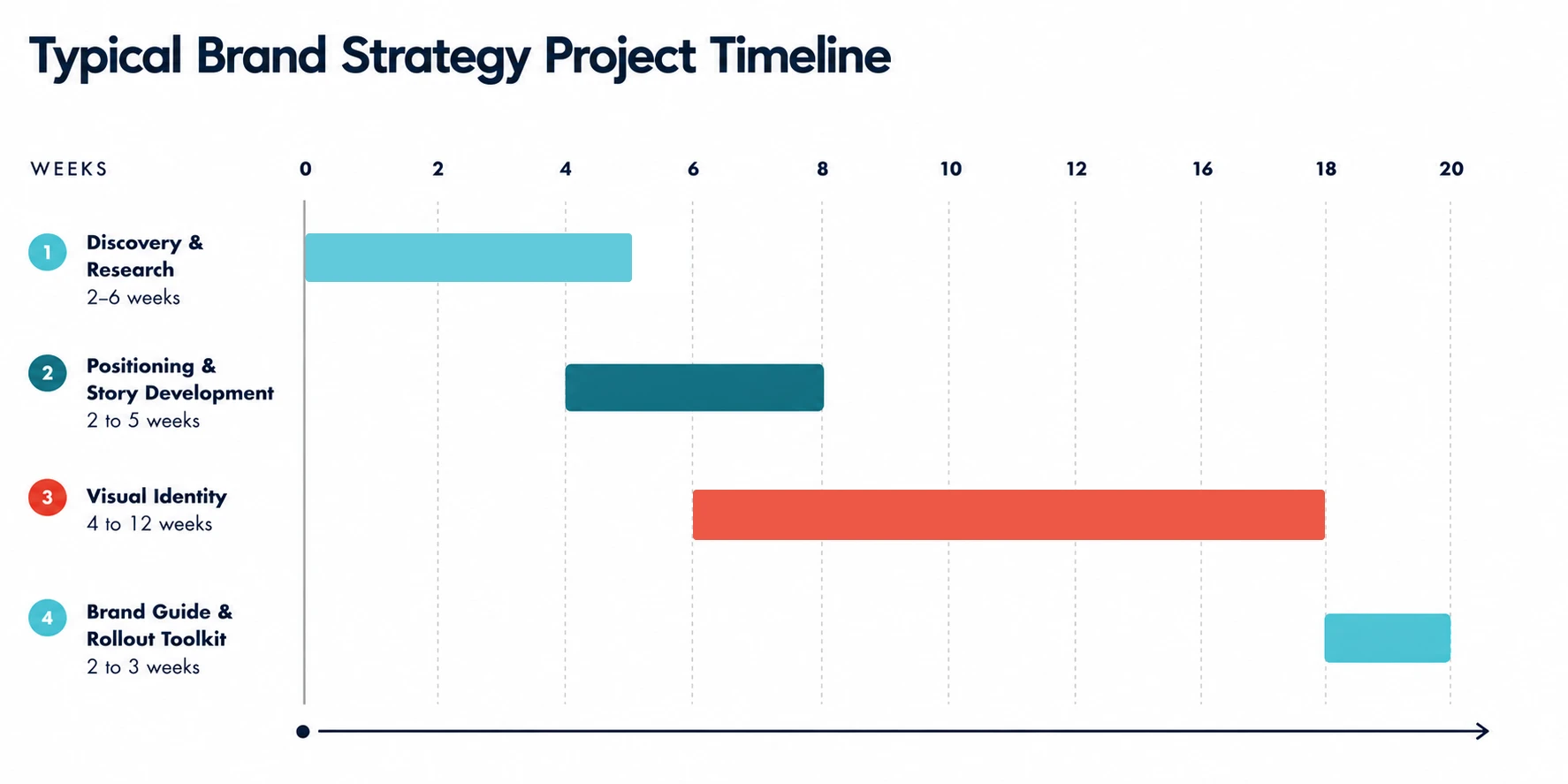
The honest answer: longer than most organizations want, and faster than most organizations expect when they think about it carefully.
A brand strategy engagement, from kickoff through final deliverables, typically runs 10 to 26 weeks, depending on the scope of work, the complexity of the organization, and how quickly stakeholders are available for input and approvals.
Here's a rough breakdown of a typical timeline:
- Discovery & Research: 2–6 weeks
- Positioning & Story Development: 2–5 weeks
- Visual Identity: 4–12 weeks
- Brand Guide & Rollout Toolkit: 2–3 weeks
A brand refresh focused on visual updates only can move faster, sometimes 6 to 8 weeks. A full corporate rebrand involving renaming, complex brand architecture, or multiple stakeholder approval tiers can run considerably longer.
The biggest variable in any brand timeline is client-side: how quickly can you get the right people in the room, provide feedback, and move decisions through your approval process? Build a realistic buffer for that.
What Does Branding Work Cost?
Brand work ranges enormously in cost depending on scope, the size and complexity of the organization, and the depth of the engagement. Here's several realistic ranges we’ve seen in our experience:
Brand Identity Refresh (visual only): $4,500 – $12,000
Updating or modernizing an existing logo, color system, and brand guide for an organization with a sound strategic foundation.
Brand Strategy + Identity: $20,000 – $40,000
Full discovery, positioning platform, brand story, visual identity system, and brand guide. The right scope for most established organizations doing serious brand work.
Full Rebrand with Naming: $40,000 – $150,000+
Discovery, research, renaming strategy and validation, positioning, visual identity, messaging framework, and rollout toolkit. This is the appropriate scope for complex organizations, corporate rebrands, or situations involving brand architecture across multiple entities. (JH- Can we say one is higher in the range than the other?)
These ranges reflect real project scopes. What drives cost up - more stakeholders, more required research, naming complexity, international considerations, larger deliverable sets, number of sub-brands, number of versions a client wishes to see, and organizations that need significant facilitation to reach alignment. What keeps cost down: a clear brief, decisive leadership, and an organization that's already done some of the strategic thinking.
What Questions Do I Need To Answer Before Starting A Rebrand?
Before you brief a brand partner or issue an RFP, do the work of answering these questions internally. Your answers don't need to be perfect — they'll be refined through the engagement. But having a starting point will dramatically improve the quality of the work.
Why Rebrand Now?
What has changed, or failed to change, that makes this the moment to address the brand? Be specific.
What Does Success Look Like?
If this project goes perfectly, what's different in 12 months? How will you know it worked?
Who Are The Key Stakeholders?
Identify the key stakeholders whose buy-in matters. Understand what each of them cares about.
Who Plays What Role In Your Branding Project?
Not every stakeholder plays the same role in your project. Determine which stakeholders fir into which role.
Who is responsible for making final decisions? Who is accountable for different components of the project? Who needs to be consulted or just informed? Misaligned expectations at the start of a brand project are the most reliable predictor of a difficult process.
What's Sacred?
Every organization has things they don't want to change. Perhaps there’s plenty of equity in the current name? Maybe a color has been around forever, or there’s a logo element that people love? Know what those are before you start, and communicate it to your designer at the project start, not after a designer has presented work you're going to reject.
What's The Honest Competitive Context For Your Brand?
Who are the real alternatives to your brand? What do they do well? Where do they fall short? The more honestly you can answer this, the sharper your differentiation can be.
What Do Your Best Customers/Clients Say About You?
Not what you hope they say. What do they actually say, in their words, when they recommend you to someone else. This is often the most useful raw material in a brand engagement, and it's often surprising. If you do not have the budget for primary research, look at online reviews, social media mentions, customer service call transcripts, post-purchase and post-service surveys, to name a few options.
What to Look for in a Brand Partner
Not all brand agencies are the same. Here's what to look for, and what to watch out for.
- A partner who asks hard questions before they show you anything.
A brand agency that leads with a portfolio and pitches creative before they understand your organization is telling you something important about how they work. Good brand partners are relentlessly curious. They want to understand you, your needs, your business, your competitive context, your audience, and your goals before they pick up a pen.
- Senior involvement throughout the project.
Agencies pitch with their best people and deliver with their junior ones. Ask specifically who will be doing the work. Think attending meetings, conducting interviews, designing concepts, not just who's presenting the proposal.
- Strategic and creative capability in the same team.
Brand strategy work requires both. Agencies that are purely strategic hand you a document and leave. Agencies that are purely creative give you a beautiful identity with no strategic foundation. The best outcomes come from teams that do both, where the strategist and the designer are in conversation with each other.
- Relevant experience, not just impressive logos.
Has this agency worked with organizations like yours — similar size, similar sector, similar complexity? Do they understand your audience? Can they point to work that solved a problem resembling the one you have? But don’t throw out the agency that does not have significant experience in your sector. You know your sector, but an agency that knows brand, asks good questions, and looks at your brand from fresh eyes will often deliver a brand that is more differentiated.
Be skeptical of agencies that tell you what your brand should be before they've listened.
The best brand strategy is discovered, not invented. It comes from understanding the organization deeply, not from imposing a framework from the outside.
What You'll Need To Bring
A great brand partner will do 80 to 90 percent of the heavy lifting. But some work can only be done by you.
- Time from the right people.
Leadership availability for discovery interviews is not optional. If the CEO or executive director isn't willing to spend a few hours in conversation, the brand work will reflect that.
- Access to clients.
The most valuable insights in most brand engagements come from talking to your best customers. You'll need to open that door.
- A decision-making process.
Know in advance how decisions will get made. Who has to approve the positioning? Who has final say on the logo? Undefined approval processes are where brand projects go to die.
- Honest feedback.
"I'll know it when I see it" is not useful feedback. Commit to engaging with the work specifically — what's working, what isn't, and why.
Ready to Start Work On Your Brand Strategy?
If you've read this far, you're already ahead of most organizations that begin brand projects. You understand what you're getting into, what it costs, how long it takes, and what makes it succeed.
The next step is a conversation. Huston Design has spent more than 25 years helping Wisconsin-area organizations — biotech companies, energy firms, healthcare organizations, research institutions, nonprofits, Madison area and national businesses of every kind — find and build their brands. We don't just create brands. We build trust, drive action, and make your message unforgettable.
Whether you're ready to move now or still figuring out scope, we're glad to spend 30 minutes helping you think it through.