

A practical resource for marketing leaders who want to start the project right.
Why Do Most Website Redesigns Fail, and What Questions Do I Need to Ask Before Starting One?
Most website redesigns do not fail because of bad design.
They fail because halfway through the project someone says:
- “Wait, who’s writing the copy?”
- “We need legal to review this.”
- “Can we also add a resource library?”
- “Did we ever schedule photography?
- “Oh no! The CEO just saw the homepage.”
Now the timeline slips three months and everyone starts using phrases like “phase two” in ways that sound suspiciously permanent. It failed because someone failed to plan.
A good redesign starts before wireframes, mockups, or development. It starts with planning. The unglamorous stuff. The decisions nobody wants to make until the project is already on fire.
This guide is here to help you avoid that.
No design jargon. No pretending your team has endless time and budget. Just a practical walkthrough of what to prepare, what decisions matter early, and what usually causes projects to drag longer than a Wisconsin winter.
1. Why Are You Redesigning the Website?
You would be surprised how many organizations answer this with:
“Because it looks old.”
Fair enough. But appearance alone is rarely the real issue.
Usually the real problem is one of these:
- Your business has evolved and the website no longer reflects it
- Your messaging is inconsistent
- Teams change and the expertise available to maintain your website goes away
- Important functions stop working
- The site is hard to update internally
- Mobile experience is frustrating
- Lead generation is weak
- The site is slow
- Navigation has become a junk drawer
- Accessibility standards are not being met
- Your team keeps apologizing for the website during sales calls
A redesign works best when you define what success actually means.
Website redesign questions to answer upfront
- What should the website help your users accomplish?
- What actions do you want visitors to take?
- What is currently frustrating users?
- What should the website help your business accomplish?
- What is the #1 lead or revenue generator on your site?
- What frustrates your internal team?
- What content still works well?
- What absolutely needs to go?
2. How Long Should My Website Redesign Take?
Universal truth: website redesigns almost always take longer than expected.
Not because designers are lounging around in black turtlenecks debating font and color philosophy. Mostly because content, approvals, and decision-making take time.
Especially when:
- More than a few people need to provide input
- Leadership wants to review everything
- Someone keeps saying “one quick tweak”
- Nobody owns the copywriting
- Your old PDFs have multiplied like rabbits since 2017
- Your core goals are poorly defined
- Not everyone is on the same page with why you are doing the redesign
Typical Website Redesign Timeline
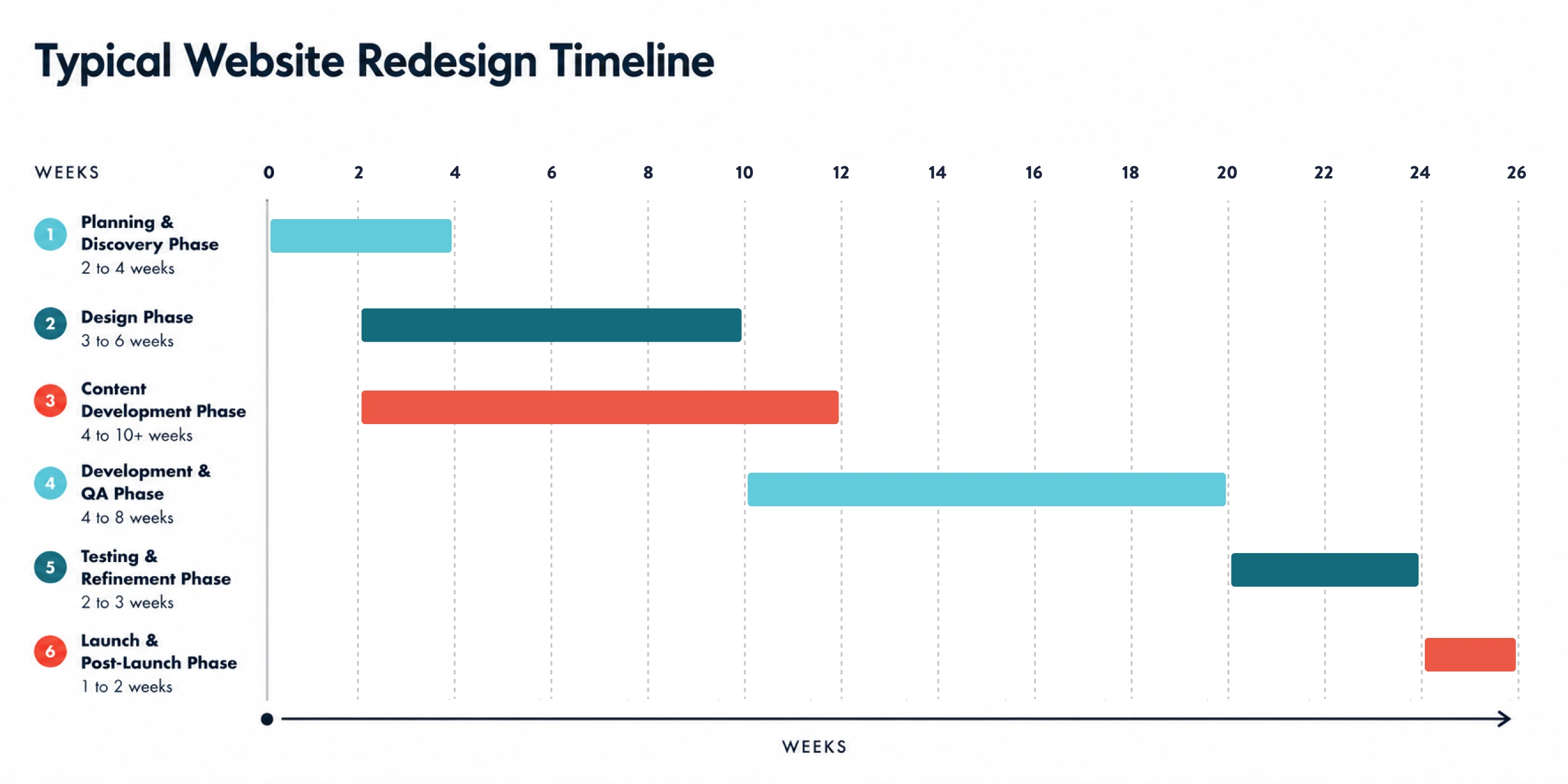
Planning & Discovery Phase
2 to 4 weeks
This includes:
- Content audit of your existing site (spoiler: half your pages are outdated)
- Kickoff meeting, stakeholder interviews, and goal setting
- Technical requirements review
- Competitive analysis and audience research
- Site architecture planning
Design Phase
3 to 6 weeks
Includes:
- Wireframes and initial home page concepts
- Interior page systems
- Mobile considerations
- Stakeholder feedback
- Design revisions (plan for at least two rounds)
- Final design approval
Content Development Phase
4 to 10+ weeks
This is where timelines go to die. It’s purely content creation and refinement.
Writing strong website copy takes longer than most teams expect. Especially when subject matter experts are busy doing their actual jobs. One thing teams forget about; aligning your subject matter expert’s copy to your brand’s tone can take time, too.
If your internal team is handling copy:
- build in extra time
- assign clear ownership
- set deadlines early
- expect revisions
And don’t forget, your team has their day job, so creating and refining copy has to happen alongside their daily routine.
Planning to shoot original photography? That's another 4-8 weeks once you factor in scheduling, shooting, and post-production. But please, please do it. Take real photos of real people, interacting and actually doing the things you and/or your customers do. It makes your website and your brands look real, not like everyone else's website. Limit posed shots. The good news is that photography can be done concurrently with content development, so you can limit the amount of time it adds to your timeline, assuming you plan for it.
Development & QA Phase
4 to 8 weeks
This includes:
- CMS setup
- Content migration
- SEO and AEO setup
- Responsive development
- Integrations of any third-party tools
Testing and Refinement Phase
2 to 3 weeks
This includes:
- User testing and feedback incorporation
- Accessibility compliance review (WCAG 2.1 AA standards recommended for most websites)
- Quality assurance testing across devices and browsers
- Load speed optimization
- Final client review and revisions
Launch and Post-Launch Phase
1 to 2 weeks
This includes:
- Launch Prep
- Site migration and launch
- Monitoring and bug fixes
- Staff training on the new CMS
- Celebrating that you actually finished
Total Realistic Website Redesign Timeline
4 to 8 months for many redesigns.
Larger or more complex sites can take longer.
And no, saying “we move fast around here” has not yet changed the laws of project management. Perception definitely is not reality when it comes to web design.
3. What Should My Website Redesign Budget Be?
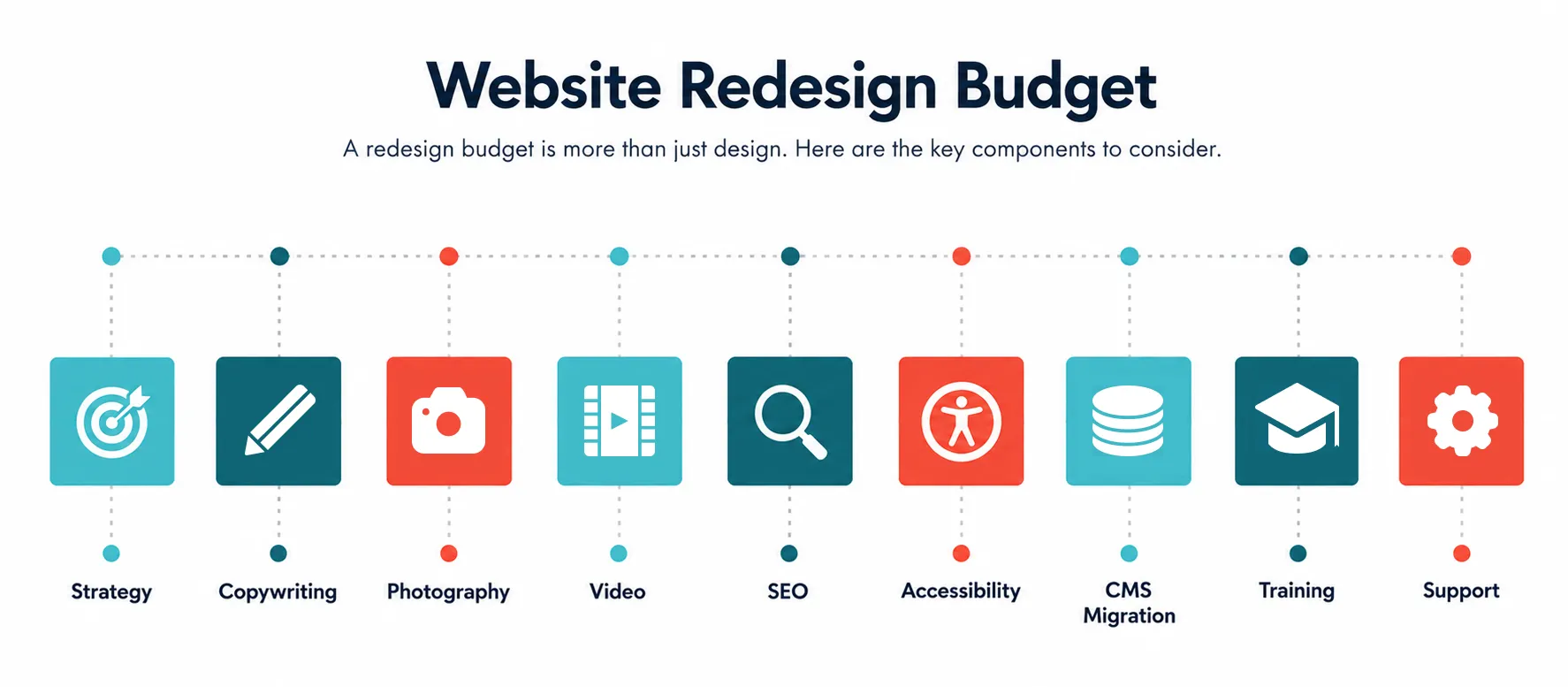
A redesign budget is not just designing the website. It may include a number of components you should consider, including:
- Strategy
- Copywriting
- Photography
- Video
- Accessibility remediation
- SEO and/or AEO work
- CMS migration
- Integrations
- Hosting
- Training
- Ongoing support
Please Stop Using the Same Smiling Stock Photo Everyone Else Has
People can spot stock photography instantly. Especially in industries where trust matters.
Custom photography:
- Builds credibility
- Reflects your actual team and facilities
- Improves brand perception
- Helps your website feel real
Unfortunately, it also requires planning, scheduling, approvals, and budget.
Easy? Rarely.
Worth it? Usually yes.
Budget Questions to Ask Early
- Are we rewriting content?
- Do we need new photography or video?
- Are there integrations with CRMs or other systems?
- Will multiple languages be needed?
- Are there accessibility requirements?
- Do we need ongoing maintenance after launch?
General Budget Reality Check
Smaller brochure-style websites cost less.
Larger sites with:
- Custom functionality
- Strategic messaging
- Extensive content
- Integrations
- Accessibility requirements
- Custom photography
- Stakeholder complexity
…cost more.
That sounds obvious written out. Yet every agency has heard:
“We want something simple.”
Followed immediately by:
“It also needs a searchable resource center, gated content, CRM integration, multilingual support, and a custom map.”
Ongoing Website Maintenance After Launch
How does your team plan to maintain/update the website post launch? Think about:
- Building/designing new pages
- Updating content
- Identifying broken links
- Applying page redirects
- Applying security patches
- Updating plug-ins or modules
4. What Should I Prepare Before A Website Redesign Project Starts?
You do not need every answer before hiring a designer or agency.
But having these items organized will save time and money. Gather these early:
Existing Website Analytics
Review:
- Most visited pages
- Highest bounce rates
- Top conversion pages
- Mobile traffic
- Underperforming content
Brand Materials
Collect:
- Logos
- Fonts
- Brand guidelines (check to be sure it’s up-to-date)
- Photography
- Presentation templates
- Existing collateral
Content Inventory
Figure out:
- What content stays
- What gets rewritten
- What gets archived
- What content is missing
- What nobody has looked at since the Obama administration
Internal Stakeholders
Identify:
- Decision-makers
- Reviewers
- Subject matter experts
- Legal/compliance reviewers
- Final approvers
This sounds boring until version 14 of the homepage appears because nobody identified who actually signs off.
Decide Who Owns Content
This is one of the biggest project questions. Answer the following, and be sure the project team and business owners agree on the answers.
- Does your internal team write copy?
- Does the agency write copy?
- Do subject matter experts contribute?
- Who has final content approval?
There is no wrong answer.
There is a wrong answer to discovering this halfway through the project.
5. Questions to Ask Before You Hire a Designer or Agency
You are not just hiring someone to make pages look nice.
You are hiring:
- Strategic thinking
- Technical execution
- Communication
- Project management
- Problem-solving
Some website redesign questions worth asking:
Process
- How do you manage timelines and approvals?
- What typically causes delays?
- What do you need from us to keep momentum?
Content
- Who handles copywriting?
- How many revision rounds are included?
- Will content migration be handled?
- Where will we house content and what is the process for managing drafts vs. final copy?
Technical
- Which CMS platforms do you recommend and why?
- How do you handle SEO and AEO during redesigns?
- How do you approach accessibility?
Design & UX
- How do you balance branding with usability?
- What is your mobile-first approach?
- How do you validate navigation decisions?
Post-Launch
- Who handles updates and maintenance?
- Will our team receive training?
- What happens if something breaks?
And yes, ask to see real examples of their work.
Not just pretty homepages.
Ask to see:
- interior pages
- mobile experience
- content-heavy sections
- complex navigation
- sites that actually support business goals similar to your own
6. Accessibility and Performance Are Not “Bonus Features”
A fast, accessible website is no longer optional.
Visitors expect:
- Fast load times
- Mobile responsiveness
- Intuitive navigation
- Readable content
- Accessible experiences
Your website should be built to WCAG 2.1 AA standards whenever possible.
Accessibility is not just about compliance. It improves usability for everyone.
And performance matters more than many organizations realize.
Slow sites frustrate users, hurt search visibility, and quietly chip away at trust.
Especially on mobile.
Especially for busy people.
7. Website Redesign Decisions That Save Projects
You do not need deep pockets to ensure the smoothest website redesign. Reduce turbulence by making decisions early. Make these decisions upfront, even before engaging with a website design partner.
Who Has Final Approval?
One person should have final decision authority. Avoid approval by committee or consensus. It’s okay to have a reasonable number of stakeholders you consult (by reasonable three at most), but at some point one person needs to make a decision. The last thing you want is homepage copy that sounds like it was written by a committee.
What Matters Most?
Remember the goals you developed for your website redesign project, prioritize your decisions based on impact to your goal. Here’s a list to help you get started.
- Lead generation
- Recruitment
- Education
- Credibility
- Conversions
- Usability
- SEO
- AEO
- Storytelling
Prioritization is key. Not everything can dominate equally.
What Is Staying the Same?
Not every redesign requires:
- New branding
- A new CMS
- A total content rewrite
- Dramatic reinvention
Sometimes the smartest redesign is focused and practical.
Less “ta-da.” More “finally.”
What Do I Really Need For A Successful Website Redesign?
A website redesign is part strategy project, part communications exercise, part group therapy.
The more clarity you create upfront, the smoother the process becomes.
You do not need every answer before starting.
But you do need:
- Realistic expectations
- Clear ownership
- Thoughtful planning
- Honest conversations about timeline and budget
Most importantly, you need momentum.
Because if your website redesign has been sitting on the “next quarter” list for three years, it may be time.
Start Planning Today
If your website no longer reflects where your organization is headed, now is a good time to start planning. A short discovery conversation can help clarify scope, priorities, and what the process might realistically look like before you commit to anything bigger.